 |
 |
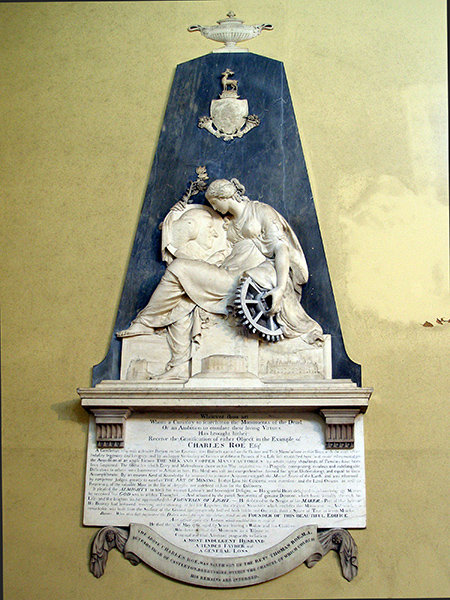 |
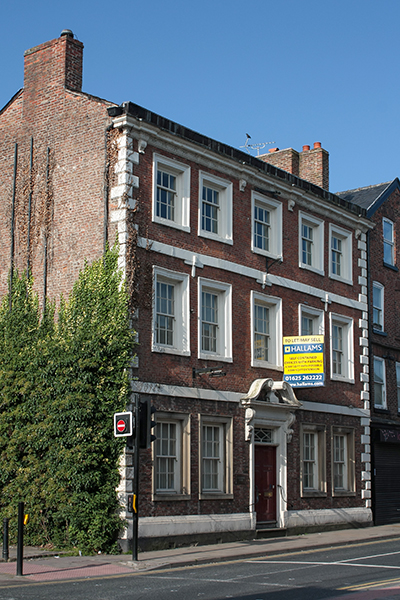
| Charles Roe House in 2014 | Memorial in Christchurch, Macclesfield |
|
|
|
|
| Charles Roe House in 2014 | Memorial in Christchurch, Macclesfield |
Charles Roe is a good example of a pioneering entrepreneur who made his mark in the 18th century. Copper ores often occurs with arsenic and the smelting process leads to contamination of the surrounding area. Even today, the top of Alderley Edge lies barren with no cover of grass.
Wikipedia informs us that Charles Roe (7 May 1715 – 3 May 1781) was born in Castleton, Derbyshire, the youngest of the eight children of Rev Thomas Roe, vicar of Castleton, and his wife Mary née Turner. His father died when he was aged eight and the family moved to Stockport, Cheshire. Soon after this his mother also died and Charles went to live with siblings in Macclesfield. According to the Oxford Dictionary of National Biography, it is thought that he was educated at Macclesfield Grammar School. He then entered the button and twist trade and became a freeman of Macclesfield in 1742. In 1743–44 he built a small spinning mill on Park Green and in 1748, in partnership with Glover & Co., a larger mill for the production of silk on Waters Green: both were based on Lombe's Mill in Derby. Roe was mayor of Macclesfield in 1747–48.
He started mining copper at Coniston in the Lake District in 1756 and around
the same time at Alderley Edge, Cheshire. In 1758 he built a copper smelter on
Macclesfield Common using coal from a shallow outcrop outside the town. He
entered into partnership with Brian Hodgson of Buxton, who had coal-mining
interests at Disley. Roe then built brass-wire and rolling mills at Eaton near
Congleton and at Bosley. Initially he bought copper ores from the Duke of
Devonshire's mine at Ecton Hill, Staffordshire (see also Ecton Mines) but then
extended his own mining interests to Penrhyn-Du in North Wales in 1763. In 1764
he obtained a 21-year mining lease from the Bayly family for Parys Mountain in
Anglesey and for a lead mine in Caernarvonshire. In March 1768 a discovery was
made of a very large deposit of copper ore, which was known as The Great
Lode and which turned the mine into the largest copper mine in Europe.
In 1767 Roe & Co. built a copper smelter on Liverpool's south shore but
following complaints about pollution the works was moved to Toxteth Park. The
company later obtained possession of a colliery at Wrexham. Both ore and coal
were landed at a small purpose built dock below the copper smelting works on
Wellington Road, Toxteth. Roe ceased mining at Alderley Edge in 1768 and at
Coniston in 1770. In 1774m
the Macclesfield Copper Company was formed comprising Roe and 14 other partners.
It became one of the three greatest brass companies of the late 18th century.
The Company's records are held by the John Rylands Library, Manchester.
In 1743, Roe married Elizabeth Lankford, daughter
of a button merchant of Leek, with whom he had three children who survived
infancy. Elizabeth died in 1750 and Roe then married Mary Stockdale in 1752 with
whom he had eight children. Mary died in 1763 and Roe married Rachel Harriott in
1766, with whom he had one son.[1]
Charles Roe was an evangelical Christian. He invited Rev David Simpson to
Macclesfield and built
Christ Church for him to undertake his ministry. Roe was buried in the
family vault in Christ Church. A memorial by
John Bacon to his memory is on the south wall of the church.
I show pictures of Christchurch and its interior on this site. Charles Roe
lived from 1753 until his death in 1781 in Charles Roe House in Macclesfield on
Chestergate. This is a Grade II* Listed building which was fully restored in
2017. The Silk Museum Heritage Centre is in the street named after him
in Macclesfield.

 Strict
